ATEX vs NEC Division: Two Frameworks, One Goal
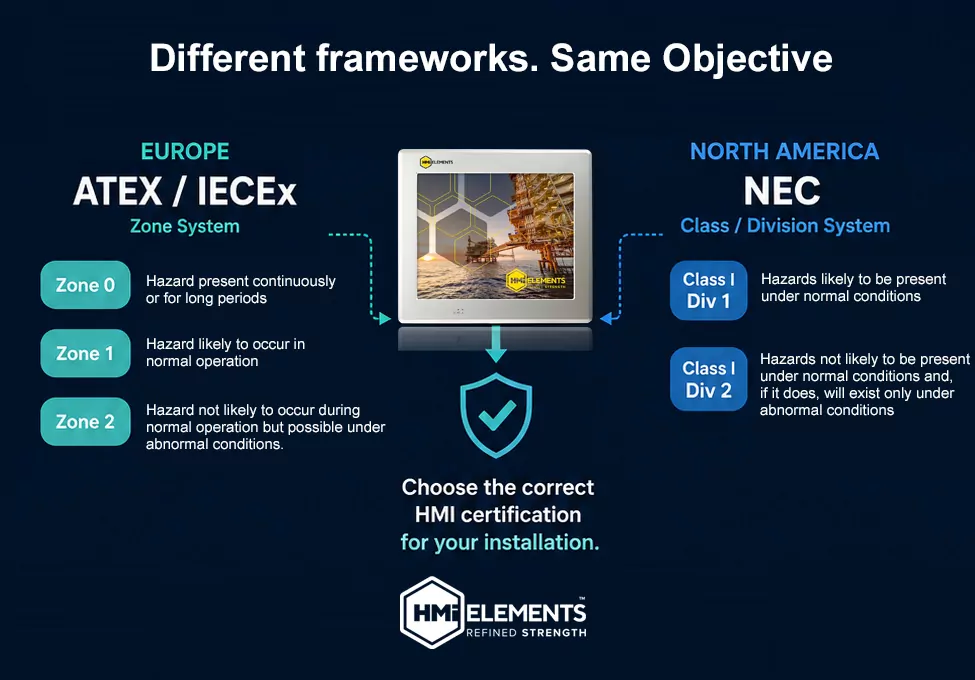
If you specify or procure certified equipment for international projects, understanding the difference between ATEX and the NEC Division system is not optional. Getting it wrong can mean additional certification costs, project delays, and non-compliant equipment at the point of installation.
Both frameworks exist to prevent ignition in hazardous areas. They evolved independently on either side of the Atlantic and are not directly interchangeable.
How they came about
In North America, the National Electrical Code introduced the Class and Division system in the early twentieth century. Class defines the type of hazard: Class I covers flammable gases and vapours, Class II combustible dusts, and Class III ignitable fibres. Division defines likelihood: Division 1 means the hazard is likely under normal conditions, Division 2 means it is only likely under abnormal conditions.
In Europe, ATEX emerged as the unified directive for explosive atmospheres, becoming mandatory across the EU in 2003. Rather than Classes and Divisions, ATEX uses Zones. Zone 1 broadly corresponds to Division 1, and Zone 2 to Division 2.
How they work together today
From the 1990s onwards, the Zone system gained recognition in North America, particularly in oil and gas. NEC 505 was introduced alongside NEC 500 to accommodate Zone classified equipment. Both systems now operate in parallel and equipment can be certified to either or both.
Gas groupings differ between the frameworks, testing standards vary, and certification markings follow different conventions. A product certified under ATEX or IECEx is not automatically compliant for the North American market without additional assessment.
For organisations operating across multiple regions, understanding which framework applies from the outset is not a technical footnote. It is a commercial necessity.
Cyber Security in Manufacturing: Awareness Is the First Line of Defence
Cyber crime is no longer a threat confined to banks, retailers, and technology companies. Manufacturing businesses are increasingly targeted, and the methods used range from sophisticated technical attacks on operational systems to straightforward manipulation of people through deception.
Phishing emails, social engineering, and credential theft account for a significant proportion of successful attacks. An employee clicking a convincing link or responding to a fraudulent request can provide an attacker with access that no technical infrastructure can prevent after the fact. In a manufacturing environment where operational continuity matters, the consequences extend well beyond data loss.
Awareness is therefore not a secondary concern, it is a primary defence.
All staff were invited to attend a practical cybercrime awareness session hosted by HMi Elements in June 2026. Delivered by the police cybercrime unit, the session covered real-world attack methods, how to recognise them, and how to respond effectively.
For a company manufacturing certified equipment for safety-critical environments, the integrity of our operations matters as much as the integrity of our products. Cyber security is an organisational responsibility, not solely an IT one, and it requires ongoing attention at every level of the business.
Product Spotlight: HMi Elements 1302-Z2 PC Workstation
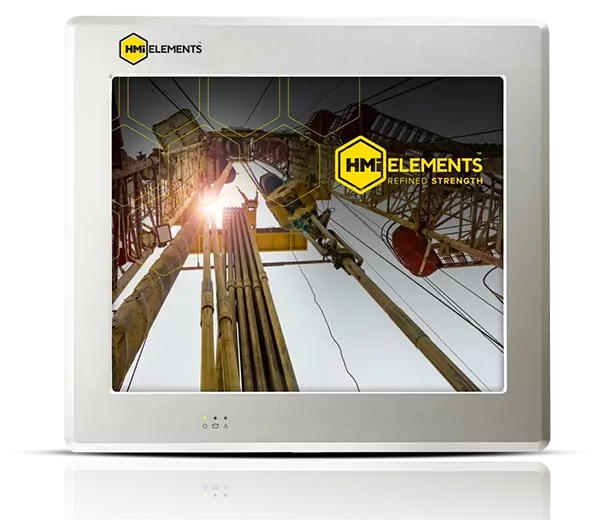
The 1302-Z2 is a 19-inch panel PC with a proven track record across oil and gas installations worldwide, designed for continuous operation in Zone 2 and Zone 22 gas and dust environments, certified to ATEX, IECEx, UKEX, and North American standards including Class I Division 2 and Class I Zone 2.
At 13kg and just 90mm deep, the 1302-Z2 is slim and lightweight by the standards of certified Zone 2 computing and is single-person portable. The enclosure is billet machined from hardened aluminium, IP66 rated and designed to meet NEMA 4X on all sides. The 19-inch, 1000 nit sunlight-readable touchscreen is glove-friendly and genuinely readable in direct sunlight. In environments where operators work with gloves on and screens are exposed to the elements, these are practical requirements, not optional features.
The operating temperature range of -40°C to +60°C covers the full spectrum of industrial deployment. Available in AC and DC variants, with a wide choice of connectivity and communication options specified at the point of order, the 1302-Z2 can be configured to the exact requirements of the installation rather than accepting a fixed standard build.
Multiple mounting options including VESA, yoke, panel, and desk stand allow flexible integration across fixed and portable deployments. The Embedded Health Monitor is fitted as standard, providing continuous visibility of internal operating conditions throughout the life of the unit.
Originally proven in oil and gas, the 1302-Z2 is well suited to any Zone 2 application where reliability, certification breadth, and long-term supportability are non-negotiable.
Attending Event: ONS 2026, Stavanger
Paul de Beer, Managing Director of HMi Elements, will be attending ONS 2026 in Stavanger from 25 to 27 August. He will be available throughout the conference and would welcome the opportunity to meet with customers, partners, and industry professionals, whether to discuss current projects, explore new opportunities, or simply catch up.
To arrange a meeting, contact us at [email protected]