Embedded Health Monitor: Real-Time Visibility, Built In
Most industrial computing platforms tell you very little about their own condition. You know the system is running, or you know it has stopped. What happens in between, the thermal stress, the voltage fluctuations and the cumulative shock loading, typically goes unrecorded.
The Embedded Health Monitor, fitted as standard across the HMi Elements 1301-Z1, 1302-Z2, and 490-Z1, changes that. Without external tools, additional software, or enclosure access, it provides continuous visibility of internal operating conditions throughout the life of the unit.
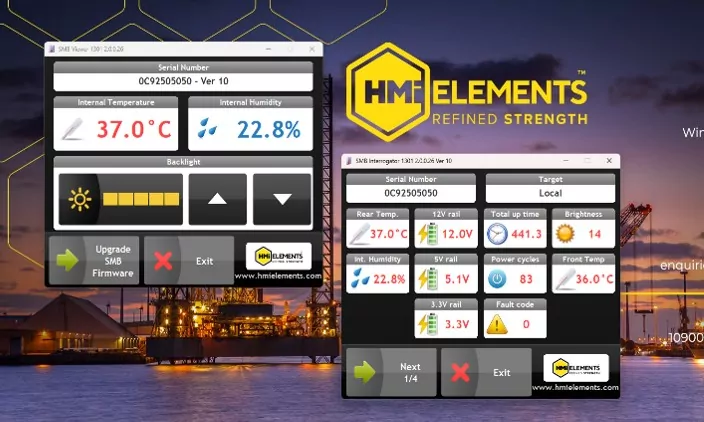
Parameters monitored include internal temperature with minimum and maximum values logged, voltage rail behaviour across the 12V, 5V, and 3.3V supplies, total powered uptime, power cycle count, shock and vibration loading across all three axes, and fault codes for first-line diagnostics. Overtemperature warnings and cold start heating indicators provide additional protection at the operating extremes.
All data is accessible through dedicated companion software supplied with each unit. The SMB (System Monitoring Board) Viewer provides a clear real-time display of current operating conditions. The SMB Interrogator gives a fuller picture of historical data, making it straightforward to assess a unit's condition without a site visit or specialist instrumentation.
Remote access diagnostics extends this further, allowing secure access to retrieve live and historic diagnostic data without being on-site at all. For installations in remote or difficult-to-reach locations, that removes a significant barrier to routine condition checks.
For the 1301-Z1, the implementation goes further, adding primary current draw monitoring and internal fuse status indication, both accessible without opening the enclosure. In Zone 1 environments where maintenance access is restricted and any intervention requires a permit, that matters.
When a unit is returned for service, the diagnostic history travels with it. When a fault occurs, first-line diagnosis does not require a site visit. In hazardous environments where unplanned downtime is costly and access is never straightforward, that level of embedded visibility is a practical advantage.
Intrinsic Safety: What It Is All About
When protecting equipment for use in hazardous areas, several approaches are available. Flameproof enclosures contain any ignition that occurs inside them. Increased safety designs eliminate the conditions that could cause ignition. Intrinsic safety takes a fundamentally different approach: it prevents ignition by ensuring there is never enough electrical or thermal energy present to ignite the surrounding atmosphere, even under fault conditions.
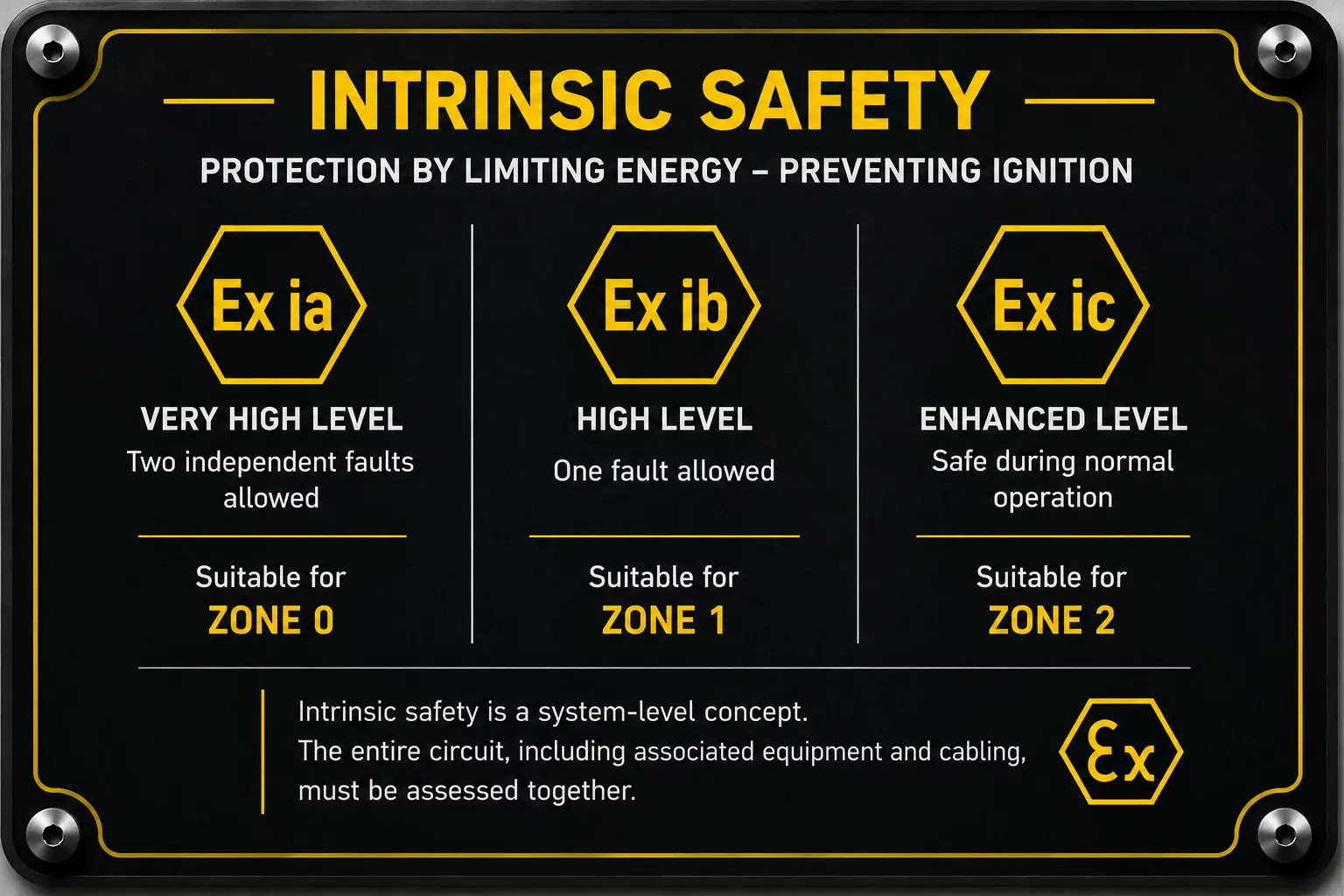
An intrinsically safe circuit limits energy to levels below the ignition threshold of a specific hazardous atmosphere. This applies not just during normal operation but under fault conditions too, depending on the protection level applied. Ex ia is the highest level, remaining safe with two simultaneous faults and suitable for Zone 0. Ex ib allows one fault and is used in Zone 1 applications. Ex ic applies to Zone 2, where normal operation safety is required but fault tolerance is not mandated to the same degree.
Because the protection relies on limiting energy rather than physical containment, intrinsically safe circuits tend to be associated with low-power devices such as sensors, instruments, and field terminals. For more complex equipment such as industrial computing systems, intrinsic safety is typically one of several protection methods used in combination, applied to specific internal circuits where energy levels can be practically controlled.
It is worth noting that intrinsic safety is a system-level concept. The barriers or isolators that limit energy into the hazardous area are as important as the field equipment itself. The entire circuit, including associated apparatus and cabling, must be assessed together.
HMi Elements Zone 1 products incorporate Ex ib intrinsic safety alongside other protection methods. Zone 2 products incorporate Ex ic. In both cases intrinsic safety works as part of a combined protection strategy suited to the demands of a full industrial computing platform.
HMi Elements at IADC World Drilling 2026, Estoril
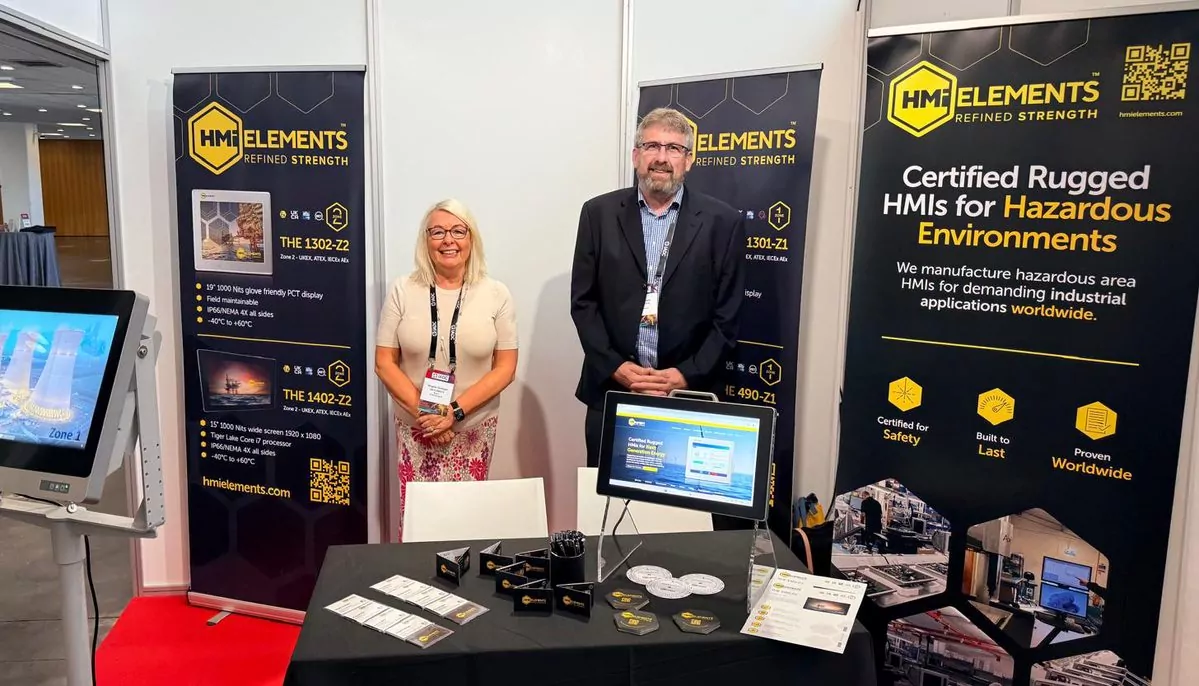
IADC World Drilling 2026 took place at the Estoril Congress Centre, Portugal on 16 and 17 June, and HMi Elements attended at Stand 19. It was a well attended conference, with over 500 delegates from drilling contractors, operators, and service companies spanning more than 30 countries across the Middle East, the Americas, Europe, Africa, and Asia. We had plenty of good conversations at the stand, and the talks themselves drew strong crowds throughout both days.
The speaker programme covered the global outlook for the industry in real depth, and this was clearly welcomed given the current climate of uncertainty. Several sessions updated their figures live as the geopolitical picture shifted during the event itself, which gave the conference a genuinely current feel rather than a fixed set of slides.
A strong automation and digitalisation thread ran through nearly every session, the part of the conference closest to our own work. The conference was very well organised by the International Association of Drilling Contractors, and the Estoril Congress Centre was a high-standard venue throughout.
An 18-month outlook
According to the speakers, the next six months look set to be fairly steady, as most regional rig fleets are already working close to capacity, while jack-up demand in the Middle East is easing back a little. Moving into 2027, available deepwater drillships are expected to become scarce, as the existing fleet ages and few new rigs are being built, pushing day rates up. Most of this growth is expected in Latin America, West Africa, and parts of Southeast Asia, as the industry leans towards developing fields in more stable parts of the world.
To arrange a meeting at either event, contact us at [email protected]